How Easy Subscriptions Can Help Your Indian Shopify Store Accept Recurring Subscription Payments Via Razorpay or UPI Autopay?
If you run a Shopify store in India and sell anything a customer needs again and again, coffee beans, protein powder, skincare, pet food, or a curated subscription box, you have probably run into the same wall. Shopify Payments doesn't work in India, and most global subscription apps are built around Stripe or PayPal, neither of which supports the way Indian customers actually pay: through UPI.
This is where Shopify recurring payments built specifically for the Indian market come in. With the right combination of a subscription app and a local payment gateway like Razorpay, you can offer customers a "subscribe once, get billed automatically" experience that feels as smooth as their OTT or DTH recharge, without chasing anyone for a payment link every month.
This article breaks down how recurring payments actually work on Shopify in India, what Razorpay and UPI Autopay bring to the table, and how a tool like Easy Subscriptions helps merchants set this up without writing a single line of code.
Why Recurring Payments Matter for Indian D2C Brands
Recurring revenue is the backbone of every subscription business. A coffee brand that sells a one-time bag of beans has to win the customer over again next month. A brand that gets the customer onto a monthly auto-billed plan doesn't have to re-sell anything, the revenue just shows up.
For Indian D2C brands in coffee, food, beauty, and wellness, this shift from one-off purchases to recurring plans changes three things at once:
- Predictable cash flow. You can forecast revenue weeks or months ahead instead of guessing based on last month's ad spend.
- Lower customer acquisition cost per order. Once a customer is on a subscription, you're not paying to re-acquire them for every repeat purchase.
- Higher customer lifetime value. Subscribers who don't have to re-order manually tend to stick around longer simply because friction is removed from the equation.
The catch is that recurring revenue only works if the payment side is recurring too. If your "subscription" is really just a reminder email asking customers to manually pay again, you don't have a subscription business, you have a really persistent newsletter. This is exactly the gap that Razorpay subscription payments and UPI Autopay are designed to close.
The Payment Problem Indian Shopify Merchants Actually Face
Shopify was built with US and European payment rails in mind. Shopify Payments, Shop Pay installments, and most native subscription tooling assume a Stripe-based checkout. Indian merchants don't have access to Shopify Payments at all, and RBI regulations around card tokenization and recurring mandates add another layer of complexity that global apps simply aren't built to handle.
That means an Indian merchant trying to run subscriptions on Shopify usually needs:
- A local payment gateway that is RBI-compliant for recurring transactions (Razorpay is the most widely used in India for this).
- A subscription management layer on top of Shopify that can create subscription products, manage billing cycles, and trigger the gateway to charge the customer automatically.
- A way to handle UPI Autopay, since UPI is how the majority of Indian consumers actually prefer to pay, not cards.
Without all three pieces working together, merchants end up stitching together spreadsheets, manual reminders, and payment links, which defeats the entire purpose of running a subscription business.
What Razorpay Brings to Shopify Subscriptions
Razorpay is one of the few payment gateways in India that has built proper infrastructure for recurring billing, rather than just accepting one-off payments. For Shopify merchants, Razorpay subscription payments typically support:
- E-mandates on cards, net banking, and UPI: a customer authorizes a recurring charge once, and Razorpay debits automatically on each billing date.
- Multiple billing frequencies: weekly, monthly, quarterly, or custom intervals, which matters for a coffee brand shipping every 30 days versus a supplement brand shipping every 60.
- Retry logic for failed payments: instead of losing the customer the moment a card expires or a bank declines a transaction, Razorpay can automatically retry the charge over the following days.
- RBI-compliant mandate management: including the additional factor authentication (AFA) requirements that RBI mandates for recurring transactions above certain thresholds.
This is the layer that actually moves money. But Razorpay by itself doesn't know what your Shopify subscription products are, when a customer's next billing date is, or what happens if someone wants to pause, skip, or cancel a box. That logic has to live somewhere else, which is where a Shopify subscription app comes in.
What UPI Autopay Changes for Ecommerce
UPI Autopay deserves its own mention because of how dramatically it has changed the recurring payments landscape in India. Where earlier customers had to trust a brand with saved card details (and many simply refused to), UPI Autopay lets them set up a recurring mandate directly through apps they already use every day, Google Pay, PhonePe, Paytm.
For a subscription-box or wellness brand, UPI Autopay for ecommerce means:
- Higher approval rates than card-based recurring payments, since UPI has become the default payment method for most Indian consumers.
- Lower drop-off at checkout, because customers don't need to enter card numbers, CVVs, or OTPs every cycle.
- Greater trust, since customers can see and manage the mandate directly inside their UPI app, including pausing or cancelling it themselves.
- Lower cost per transaction compared to card processing fees in many cases.
In short, UPI Autopay solves the trust and friction problem that used to make Indian consumers hesitant about auto-billing. Once a customer sets up a UPI mandate for their monthly coffee subscription, the brand doesn't need to do anything further, the payment just happens on schedule.
How Easy Subscriptions Fits Into This Picture
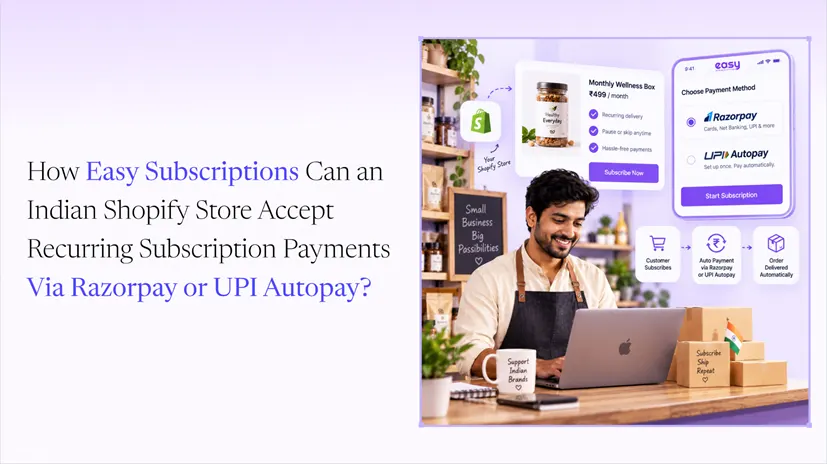
This is where the Shopify subscription app layer matters. Easy Subscriptions is built to sit between your Shopify store and Razorpay, handling the parts that Razorpay alone doesn't manage: subscription product setup, billing schedules, customer subscription management, and syncing successful or failed charges back into Shopify orders.
In practice, this looks like:
- Setting up subscription plans directly on product pages, weekly, monthly, or custom intervals, without touching Shopify's Liquid theme code.
- Connecting to Razorpay so that every recurring charge is processed through UPI Autopay, cards, or net banking, depending on what the customer chooses at checkout.
- Automatically creating Shopify orders each time a payment succeeds, so your fulfillment and inventory systems stay in sync without manual entry.
- Handling failed payments through retry sequences and customer notifications, rather than silently losing the subscriber.
- Giving customers a self-serve portal to skip a delivery, change their plan, update their payment method, or cancel, reducing support tickets significantly.
The goal of a subscription app like this isn't to replace Razorpay, it's to make Razorpay's recurring payment infrastructure actually usable inside a Shopify store, with the merchant-facing tools (analytics, churn tracking, plan management) that a payment gateway alone was never designed to provide.
Setting Up Shopify Subscriptions With Razorpay: A Practical Walkthrough
For merchants evaluating this setup, the general implementation path looks roughly like this:
- Install a subscription app (such as Easy Subscriptions) from the Shopify App Store.
- Connect your Razorpay account through the app's payment gateway settings, this usually involves generating API keys from your Razorpay dashboard and entering them into the app.
- Create subscription plans for your products, decide on billing frequency, trial periods (if any), and discount structures for subscribers versus one-time buyers.
- Enable UPI Autopay as a payment option at checkout, alongside cards nd net banking, so customers can choose their preferred mandate type.
- Test the full cycle, from a customer subscribing, to the first charge, to a renewal charge on the next billing date, to what happens if a payment fails.
- Set up failed-payment recovery, configure retry attempts and customer email/SMS notifications so a declined UPI mandate or expired card doesn't silently churn a subscriber.
- Monitor subscription metrics, churn rate, monthly recurring revenue, and failed payment recovery rate, through the app's dashboard rather than digging through raw Razorpay transaction logs.
None of this requires custom development work from the merchant's side, which is the entire point of pairing a subscription app with a payment gateway rather than building a bespoke billing system from scratch.
Where Mobile Commerce Fits Into the Subscription Story
It's worth zooming out here, because payment automation doesn't exist in isolation, it's part of a broader shift toward mobile-first commerce in India. UPI itself is a mobile-native payment rail; the mandate approval happens on a phone, the notification arrives on a phone, and for a growing share of Indian shoppers, the entire purchase journey, from discovery to checkout to subscription management, happens on a phone screen.
For Shopify merchants thinking beyond the storefront, this raises a natural next question: how much of the subscription experience is genuinely optimized for mobile? A checkout that renders awkwardly on a small screen, or a subscription management portal that's hard to navigate on mobile, undoes a lot of the convenience that UPI Autopay is supposed to deliver. This is the kind of gap that shows up as silent churn, customers who don't cancel outright, but who quietly stop engaging because the experience wasn't built with their device in mind.
This is also where enterprise mobility and app development work, the kind NexMobility specializes in, starts to intersect with ecommerce operations. Brands scaling recurring revenue often reach a point where a fully custom mobile app, deeper UPI integration, or automation across their subscription and fulfillment stack makes more sense than stitching together apps and plugins. Recurring payments are the foundation; a well-built mobile experience is often what determines whether that recurring revenue actually compounds.
Getting the Fundamentals Right First
Before reaching for more advanced mobile or automation tooling, it's worth getting the fundamentals of Shopify payments in India right: a compliant gateway, a subscription app that speaks to it correctly, and a UPI Autopay option that meets customers where they already are. Getting these three right removes the single biggest point of friction in Indian subscription commerce, the payment itself.
For Indian Shopify merchants exploring recurring payments for Shopify, Easy Subscriptions paired with Razorpay's UPI Autopay support offers a straightforward, RBI-compliant way to move from one-off sales to genuine subscription revenue, without needing a development team to build billing infrastructure from the ground up. From there, the conversation shifts to what most growing D2C brands eventually need to think about: retention, customer experience, and how mobile-first thinking can turn a subscription base into a durable, scalable business.
FAQs
Can Indian Shopify stores accept recurring subscription payments?
Yes. Since Shopify Payments isn't available in India, merchants use a subscription app connected to a local gateway like Razorpay to process recurring charges via UPI Autopay, cards, or net banking.
What is UPI Autopay and how does it work for ecommerce subscriptions?
UPI Autopay lets customers authorize a recurring payment mandate through their UPI app (like Google Pay or PhonePe). Once set up, payments are debited automatically on each billing cycle without requiring manual approval every time.
Does Razorpay support subscription billing on Shopify?
Razorpay supports recurring payments through e-mandates on UPI, cards, and net banking, including retry logic for failed transactions. It needs to be paired with a Shopify subscription app to manage plans, billing schedules, and order creation.
What happens if a recurring UPI Autopay payment fails?
Most subscription apps, including Easy Subscriptions, automatically retry failed payments over the following days and notify the customer, reducing involuntary churn from expired cards or bank declines.
Do I need coding skills to set up Shopify subscriptions with Razorpay?
No. Subscription apps like Easy Subscriptions are designed for no-code setup, merchants connect their Razorpay account, create subscription plans, and enable UPI Autopay directly from the app dashboard.